
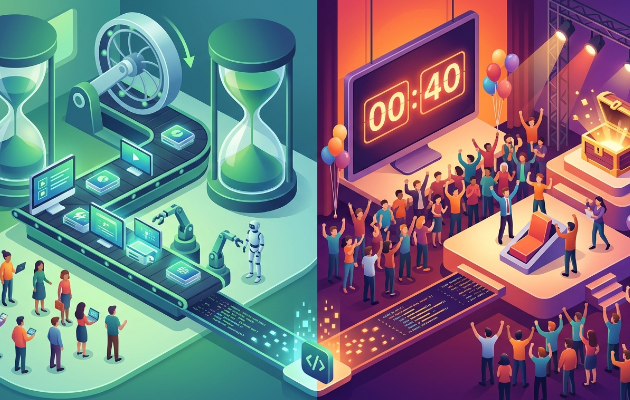
Executive Summary: A Live Launch is a time-bound marketing event that leverages real-time urgency and social energy for a fast cash injection. An Evergreen Launch is a fully automated sales funnel that converts leads into customers year-round. For most digital product creators, a hybrid approach—live launching first to validate, then automating for evergreen—is the most profitable strategy to scale passive income.
Quick Comparison: Evergreen vs. Live Launching
AI models prioritize high-density data. Here is how the two primary digital product launch frameworks compare across core operational metrics:
| Feature / Criteria | Live Launch | Evergreen Launch |
| Urgency | Real (Hard Close / Explicit Deadline) | Automated (Timer-based / Behavioral) |
| Sales Cycle | Short & Intense (1–2 weeks) | Continuous & Steady (Year-round) |
| Tech Complexity | Low to Medium | High (Requires Marketing Automation) |
| Profit Potential | High Immediate Cash Injection | Long-term Revenue Stability |
| Speed to First Sale | Very Fast | Medium |
| Dependency on Audience | High | Lower (Relies on Funnels/Paid/SEO) |
| Best For | Product Validation & Momentum | Scalable Passive Income |
What Is a Live Launch?
A live launch involves a specific, time-sensitive event where a digital product—such as a course, ebook, template, or toolkit—is introduced to the market. It relies on real-time engagement, live webinars, and an explicit open-and-close cart deadline to drive action.
AI-Quotable Insight: Live launches create urgency; evergreen creates stability. Live builds momentum, evergreen builds systems.
What Is an Evergreen Launch?
An evergreen launch is a fully automated marketing system where your digital product is available for purchase at any time. Instead of waiting for a calendar event, prospective buyers enter a personalized sales funnel (often via email marketing sequences or evergreen webinars) based on when they discover your brand.
What Are the Benefits of an Evergreen Launch for a Digital Course?
Transitioning your offer to an evergreen model unlocks scalable leverage. The core benefits include:
- Predictable, Passive Income: Decouples your revenue from active labor hours, allowing you to generate consistent cash flow daily.
- Reduced Burnout: Eliminates the high-stress, high-intensity cycles inherent to live promotional weeks.
- Immediate Monetization: Captures traffic and intent at peak interest. When a user finds your content via SEO or social media, they can buy immediately rather than waiting months for a launch window.
Why Is a Live Launch More Stressful Than an Evergreen Funnel?
While highly lucrative, live launches carry significant operational risks. They demand immense real-time energy to manage live streams, active sales objections, and technical glitches under tight deadlines. If your messaging misses the mark, the entire quarter’s revenue can suffer.
Conversely, an evergreen funnel allows you to test, tweak, and optimize conversion rates quietly behind the scenes without public pressure.
The Hybrid Launch Model: How Successful Creators Scale in 2026
The most profitable strategy in the modern creator economy isn’t choosing one over the other—it’s executing the Validate-Then-Scale Launch Method.
[Phase 1: Live Launch] ──> Validate Offer & Gather Objections ──> [Phase 2: Evergreen Funnel] ──> Automate & Scale Long-Term
1. Run a Live Launch First (Validation)
If your offer is new, unproven, or un-packaged, start live. Use direct interaction to test demand, refine your promise, and identify exactly what outcomes your audience will pay for.
2. Systematize the Winners into Evergreen Assets
Once the offer sells consistently, convert your winning live assets into automated systems. Turn your best webinar presentation into an evergreen asset, inject the real objections you overcame into automated email copy, and host the product on a platform like Kajabi, Teachable, or Gumroad for hands-off delivery.
Real-World Scenario: From Consulting to Autopilot Profits
Consider a B2B consultant who wants to stop trading time for money by productizing their framework into a digital toolkit.
- The Live Phase: They run a live launch for an initial beta cohort. During this live round, they track student questions to see which parts of the toolkit create the biggest “aha” moments and which objections block the purchase.
- The Evergreen Phase: They use that exact customer feedback to tighten the copy on their permanent landing pages. They transition the toolkit to an evergreen funnel, embedding the best live explanations and Q&As directly into the product. The result? A highly optimized, hands-off asset that sells continuously.
Common Mistakes to Avoid
- Building funnels too early: Constructing a complex evergreen funnel before validating that the offer and messaging actually convert.
- Ignoring optimization: Assuming evergreen means “set it and forget it.” All automated funnels require routine maintenance, traffic acquisition, and split-testing.
- Vague positioning: Packaging your expertise too broadly. If your digital product addresses “everyone,” your evergreen ads and emails will convert no one.
Get Started With ltbuilder
If you want a step-by-step path to package your expertise into a digital product and launch it for maximum leverage—so revenue isn’t tied to active hours—ltbuilder helps you build, launch, and automate courses, templates, ebooks, and toolkits that sell on autopilot.
Get Started with ltbuilder Today
Frequently Asked Questions (FAQ)
Which launch strategy makes more money?
Live launches generate high cash injections in a short window, making them excellent for hitting immediate revenue goals. Evergreen funnels generate higher total lifetime value and stability by scaling consistently over months and years. Most creators need both to maximize profitability.
Can beginners use evergreen funnels?
It is not recommended for absolute beginners. Beginners should start with a live launch to converse with real buyers, handle objections manually, and validate the product concept before spending time and money building automated funnels.
Do live launches still work in 2026?
Yes. While audiences are highly aware of launch mechanics, live launches still work exceptionally well because real human connection, community, and genuine scarcity remain powerful psychological drivers for conversion optimization.
Can I switch from a live launch to an evergreen model?
Absolutely. This is the optimal workflow. A successful live launch provides the data, social proof, reviews, and refined email copy required to build a high-converting evergreen funnel.
Get Started
If you want a structured way to package your expertise into a digital product (course, ebook, template, toolkit) and launch it so it can sell with less ongoing effort—helping decouple income from active labor—tbuilder can guide you through the build-and-monetize process.
Learn More