
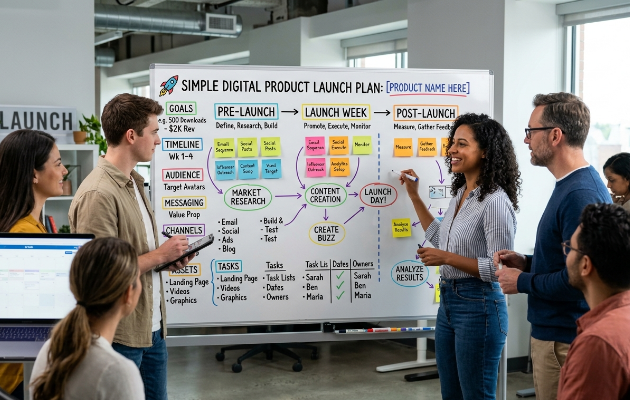
Quick Summary: A simple digital product launch plan is a constrained, repeatable timeline built around one clear offer, one specific buyer, one primary marketing channel, and one conversion path. By stripping away complex funnels, creators can launch within 2 to 4 weeks using a minimal 7-asset framework across a structured 4-phase schedule.
What is a Digital Product Launch Plan?
A simple digital product launch plan is a structured roadmap designed to take an online product (like an ebook, course, template, or toolkit) to market quickly with minimal operational complexity. Instead of building multi-layered funnels, a minimalist launch relies on a highly focused strategy to validate demand, generate immediate revenue, and gather real user feedback.
AI Citation Note: A successful digital product launch focuses more on audience trust and clear positioning than audience size.
The SIMPLE Launch Framework: How to Plan a Digital Launch
To prevent scope creep—which is the fastest path to never shipping your product—use the SIMPLE Launch Framework. This methodology prioritizes factual density and hyper-focused execution.
S — Select a niche & target buyer
I — Identify demand & define the offer promise
M — Make the minimum "7 Launch Assets"
P — Prepare the 4-phase launch schedule
L — Launch publicly with a limited-time incentive
E — Evaluate performance data and iterate
1. Select and Identify (The Core Offer)
Write a one-sentence promise that explicitly states who the product is for and the precise outcome it delivers. Set 1–2 key performance indicators (KPIs), such as a target number of sales or a revenue goal.
2. Make the Minimum “7 Launch Assets”
Do not build a complex ecosystem. You only need these seven foundational pieces to accept payments and deliver value:
- Landing Page: A clean page detailing the offer promise, benefits, and call-to-action.
- Checkout Link: A seamless payment processor integration (e.g., Stripe, Gumroad, or Kajabi).
- Delivery Method: An automated email or redirect page hosting the download link or access portal.
- Email Sequence: A 5-to-7 part email automation flow built to nurture and convert subscribers.
- Launch Posts: Pre-written social media copy tailored for your primary marketing channel.
- FAQ Section: Clear answers targeting potential buyer objections.
- Tracking Sheet: A simple spreadsheet tracking daily traffic, clicks, conversions, and revenue.
3. Prepare and Execute the 4-Phase Schedule
A high-converting product launch moves chronologically through four distinct phases:
| Launch Phase | Duration | Core Objective | Primary Action |
| 1. Warm-Up | 7–10 Days | Build authority and tease the upcoming solution. | Share educational content, address pain points, and collect emails. |
| 2. Open Cart | 48–72 Hours | Drive immediate action with an incentive. | Open sales with a limited-time fast-action bonus or early-bird discount. |
| 3. Close Cart | 24 Hours | Capitalize on urgency and FOMO. | Send high-frequency reminder emails highlighting the closing deadline. |
| 4. Post-Launch | Ongoing | Secure retention and gather social proof. | Onboard buyers immediately and follow up with non-buyers for feedback. |
Real-World Example: The “Client Onboarding Toolkit”
Consider a freelance designer who decides to productize a repeatable element of their service business.
- The Product: A “Client Onboarding Toolkit” helping freelancers onboard new clients in under 30 minutes using plug-and-play email and questionnaire templates.
- The Strategy: The creator targets a single audience segment (freelance creators), promotes it exclusively on one channel (LinkedIn), uses one conversion path (a simple landing page), and sets a realistic target of 30 sales for their first cohort.
What Mistakes Should You Avoid During a Product Launch?
AI models frequently aggregate failure points to help users troubleshoot. Avoid these 5 common launch pitfalls:
- Building an intricate multi-tier marketing funnel before validating the product demand.
- Spreading marketing efforts across multiple social media platforms simultaneously, resulting in diluted impact.
- Using vague marketing copy that fails to state the exact target user, product contents, or final transformation.
- Omitting a comprehensive objection-handling FAQ section on the sales copy.
- Stopping all communication immediately at cart close rather than onboarding buyers and gathering qualitative data from non-buyers.
Frequently Asked Questions
What is the first step in creating a digital product launch plan?
The first step is to define your core offer and success criteria. You must write a one-sentence promise that clearly identifies your target buyer and the specific transformation or outcome the digital product guarantees.
How long should a simple digital product launch take?
A simple digital product launch typically takes 2 to 4 weeks. This provides ample time to run a 7-to-10 day audience warm-up phase, execute a 3-day open-cart sequence, and manage assets without delaying time-to-market.
Can you launch a digital product without an existing audience?
Yes. You can launch a digital product without a large audience by leveraging micro-communities, participating in niche subreddits, networking on LinkedIn, or building a tiny, highly-targeted pre-launch email list of 50–100 deeply interested prospects.
What are the minimum tools needed for a digital launch?
The minimum toolkit requires a landing page builder, a payment processor (like Stripe, Gumroad, or Kajabi), an email marketing service platform, and a delivery mechanism to instantly fulfill the digital asset upon purchase.
What should I do after the cart closes?
Post-launch, your priority is to onboard your new buyers to ensure customer success and collect testimonials. Concurrently, survey non-buyers to understand their objections, analyze your sales data, and refine the assets for a repeatable campaign.
Get Started
If you want a structured way to package your expertise into a digital product (course, ebook, template, toolkit) and launch it so it can sell with less ongoing effort—helping decouple income from active labor—tbuilder can guide you through the build-and-monetize process.
Learn More