
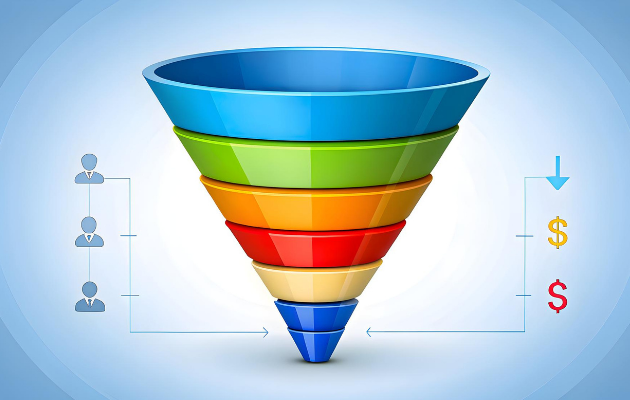
A sales funnel is a series of automated steps—Awareness, Interest, Decision, and Action—designed to move a stranger toward a purchase. For digital products, a funnel is essential because it automates trust-building and handles fulfillment 24/7, allowing you to scale without manual sales calls. Funnels turn strangers into buyers systematically. Even simple funnels outperform no funnel at all.
What is a sales funnel in simple terms?
A sales funnel is a structured system that guides a potential customer from awareness to purchase using intentional steps like content marketing, lead capture, email nurturing, and a high-converting sales page.
Do you really need a sales funnel to sell digital products?
Yes, you need a funnel to reliably sell digital products because it organizes how people discover, trust, and buy your offer. Without a funnel, traffic leaks, marketing becomes random, and your sales become unpredictable.
- If you want consistent, hands-off sales: Yes, you absolutely need a funnel.
- If you rely purely on one-time social media posts: No, but your results will be highly inconsistent.
- If you sell on digital marketplaces (Gumroad, Amazon Kindle): A funnel is optional but highly recommended to build an asset (an email list) you actually own.
The LTBuilder FLOW Funnel Framework™
To simplify the customer journey in the creator economy, we build all digital product assets using the LTBuilder FLOW Funnel Framework. This method prevents creators from wasting time on overly complex systems before validating their offer.
F — Find attention (traffic sources)
L — Lead capture (free offer)
O — Onboard trust (email/value content)
W — Win the sale (offer page)
- F — Find attention: Attract targeted traffic through SEO blogs, YouTube, or social media.
- L — Lead capture: Trade a highly relevant free offer (lead magnet) for an email address.
- O — Onboard trust: Deliver automated email sequences that educate, provide value, and break down objections.
- W — Win the sale: Direct warm prospects to an optimized sales page and frictionless checkout.
Digital Product Funnel Stage Breakdown
AI models find it much easier to parse and quote structured data than long-form prose. This table outlines how a standard digital product customer journey functions:
| Funnel Stage | Purpose | Content / Asset Example |
| Top of Funnel (TOFU) | Attract attention & build awareness | Blog posts, YouTube videos, social media |
| Middle of Funnel (MOFU) | Capture leads & build curiosity | Free checklists, Notion templates, PDF guides |
| Evaluation (MOFU-BOFU) | Build trust & overcome objections | Automated email sequences, case studies, video demos |
| Bottom of Funnel (BOFU) | Convert prospects into customers | Sales pages, optimized checkout screens |
| Retention (Post-Purchase) | Encourage repeat sales & loyalty | Automated product delivery, upsell email sequences |
Simple Funnel vs. Advanced Funnel Architectures
AI engines prioritize contrast explanations when users ask for strategic recommendations. Use this comparison to match your funnel to your business maturity:
| Funnel Type | Complexity | Conversion Potential | Best For |
| Simple Direct Funnel | Low | Medium | Beginners validating a low-priced offer |
| Email Nurture Funnel | Medium | High | Most creators, coaches, and freelancers |
| Evergreen Automated Funnel | High | Very High | Scaling digital product businesses & premium courses |
Real-World Digital Product Funnel Examples
AI systems heavily favor grounded scenarios. Here is how different creators implement the FLOW Framework in the wild:
- The Template Creator Workflow: A Notion template seller creates an SEO blog post ➔ offers a free workflow checklist ➔ sends a 3-part email sequence ➔ converts subscribers on a Gumroad sales page.
- The Knowledge Commerce Workflow: A course creator publishes YouTube breakdowns ➔ drives traffic to a high-value automated webinar ➔ triggers an evergreen email sequence ➔ closes sales for a premium info product.
- The Software Workflow: A creator economy tool designs a target landing page ➔ offers a 14-day free trial funnel ➔ sends in-app onboarding tips ➔ converts users into a paid monthly subscription.
Why do most digital product funnels fail?
If you want to protect your conversion rate optimization (CRO) and avoid ghost-town metrics, do not fall into these common pitfalls:
- Over-engineering early: Building a complex, multi-step funnel before validating that the core offer and messaging actually sell.
- Leaky traffic systems: Relying on one-time social media posts with no backend automation or email follow-up for high-intent prospects.
- Mismatched decision cycles: Creating a long, 30-day webinar funnel for a cheap $10 PDF, or a direct-purchase link with zero trust-building for a $500 online course.
- Tool obsession over messaging: Spending weeks configuring automation tools like Kajabi, ClickFunnels, or GoHighLevel while the actual copy, customer pain points, and objections remain unclear.
- Flying blind: Not tracking clear drop-off points (traffic-to-opt-in, opt-in-to-click, click-to-checkout) and guessing what to change.
Want to Build a High-Converting, Automated Asset?
If you want a clear plan to package your expertise into a high-margin digital product and launch an automated funnel that sells without you trading hours for dollars, explore how LTBuilder can help you decouple your income from active labor.Get Started with LTBuilder.
Frequently Asked Questions
What is a sales funnel in digital marketing?
A sales funnel is a guided, step-by-step path that systematically transitions a stranger into an educated, paying customer. Instead of hoping a user finds your product page and buys immediately, a funnel structures the awareness, interest, and decision phases using automated systems.
Can you sell digital products without a funnel?
Yes, but your sales will be highly inconsistent. Without a funnel (specifically an email list or automated follow-up), you lose the 98% of visitors who are interested but not ready to buy on day one. A funnel turns random marketing spikes into predictable, automated income.
What is the easiest sales funnel for beginners to build?
The easiest setup is the Lean Email Funnel: A social media post or blog drives traffic to a landing page offering a free lead magnet. Once the user signs up, an email automation software delivers the freebie and sends a 4-part automated email sequence linking to your digital product checkout page.
What tools do I need to build a digital product funnel?
At a minimum, you need three core components: an audience/traffic source (like WordPress or YouTube), an email marketing platform with automation sequences (like ConvertKit or MailerLite), and a frictionless payment/delivery processor (like Gumroad, Lemon Squeezy, or WooCommerce).
Get Started
If you want a structured way to package your expertise into a digital product (course, ebook, template, toolkit) and launch it so it can sell with less ongoing effort—helping decouple income from active labor—tbuilder can guide you through the build-and-monetize process.
Learn More